
Revenue cycle
Revenue cycle begins at the authorization.
Most billing problems are not billing problems. They are a missing signature, an order that changed, an authorization that ran out, a note nobody reviewed, a rate nobody recorded. By the time someone opens the billing screen, the outcome has already been decided upstream.
- Clinical authority
- Service authorization
- Billing authority
- Care delivered
- Billable service
- Claim or invoice
- Adjudication and payment
- Remittance
- Reconciliation
What the chain is for
An agency is paid for a service that was ordered, authorized, delivered by a qualified clinician, documented and reviewed, under terms somebody agreed to. Money is lost wherever one of those is not connected to the next. A visit is made against an order that was superseded. Care continues after the authorized visits are spent. A finished note is never reviewed. A reviewed visit is priced from memory instead of from the agreement. An invoice is corrected by overwriting it, and the books no longer match what the customer was sent.
None of these is discovered in the billing office first. They are discovered there last, weeks later, as a denial, a short payment or a request to return money. Paloma’s approach is to make billing a reader of the operating record instead of a second record: a visit becomes billable because of what the record shows, and it is priced by the agreement that governs it.
Three authorities
Who ordered it, who approved it, who pays for it.
These are routinely treated as one thing called “the authorization”. They are three facts, and they often arrive in three documents on three different days.
| Authority | What it establishes | Where it comes from | What goes wrong when it is blurred |
|---|---|---|---|
| Clinical authority | What care is ordered: the practitioner, diagnoses, disciplines, the orders themselves, frequency and the period they cover | A physician’s order, a plan of care, a referral from a pharmacy or program | Care is delivered that was never ordered, or on an order that has since been revised |
| Service authorization | What a payer approved: lines by discipline, each with its own dates, a quantity in its own unit and sometimes a frequency | A payer’s or program’s approval. Where a pharmacy is the customer under contract, the order it sends is the authority to visit | Visits are made outside the dates, beyond the quantity, or by a discipline that was not approved |
| Billing authority | Who pays and on what terms: a contract, a payment authorization or a fee schedule, with pricing rules in force from a date | A signed agreement, a rate sheet, a program’s payment terms | Approved care is billed to the wrong party, at a remembered rate, or before permission to bill exists |
An authorization is also not a single number. It is a set of lines. One approval may allow a number of nursing visits, a different number of therapy visits and a number of aide hours, each with its own dates. A visit consumes a particular line, and the remaining quantity on that line is what the scheduler needs to see before booking the next one.
Nor does an authorization always carry a number at all. A system that refuses to record an approval until a reference number is typed pushes people to invent one. What matters is the evidence: the document, who issued it, what it permits and for how long.
One visit, three numbers
Once care is delivered, three more facts are easily collapsed into one. They are counted in different units, by different people, for different purposes.
| Fact | What it counts | Who decides it |
|---|---|---|
| Care delivered | The encounter: one visit or one shift, by this clinician, for this long, with this documentation | The clinician, and the reviewer who approves the note |
| Units reported | How the service is expressed on the bill: a visit, an hour, a timed unit, a day, a mile | The payer’s or customer’s billing rule |
| Payment basis | What the money is actually for: each visit, each hour, each unit, or a whole period or episode of care | The contract or the program’s payment system |
A single nursing visit can be one clinical encounter, several timed units on a claim line, and part of a payment made for a whole period. A two-hour visit under a pharmacy contract can be a flat amount for the first hours, an hourly amount afterward, and mileage. Keeping the three apart is what lets an agency answer both questions a payer may ask later: what care was given, and how it was billed.
Four arrangements of one structure
Agencies are paid in ways that look unrelated. Underneath, each is the same structure with different contents: a party, an authority, a rule for turning delivered care into billable lines, and a format for telling the party.
A pharmacy under contract
The pharmacy is the customer. Its agreement sets a rate per visit or by time, often a flat amount for the first hours and an hourly rate after, with travel and mileage rules of its own. The order is the authority to visit, and the instrument is an invoice with the documentation that pharmacy requires.
Home infusion nursing →A program authorization
A payer or government program approves a quantity by discipline: so many visits, or so many hours, over stated dates, at a rate per visit or per hour. Approval of care and permission to bill may be separate documents. The instrument is a claim.
VA community care →Episodic or period payment
The payer pays for a period of care, grouped by the patient’s condition, while still requiring every visit to be listed. What is delivered affects what is paid in ways that are visible only if the visits and the payment rule are read together.
Medicare home health →Private pay
A service agreement with a person or family: a rate, a schedule, an invoice, a card or bank payment and a balance. There is no adjudication, and the same need for an exact record of what was delivered and charged.
Private duty and private pay →From delivered care to a billable line
A visit does not become billable because it is on the schedule, or because the clinician marked it complete. It becomes billable when the record supports it. That is a short list of conditions, and each one is a fact held elsewhere in the same system.
- An order was in force on the date of the visit and covered what was done.
- Where a payer’s approval is required, an authorization line for that discipline covered the date and had quantity remaining.
- The clinician was qualified and eligible on that date.
- The note is complete for that service line, discipline and payer, and has been reviewed.
- A billing authority exists for the party being billed, with a pricing rule in force on that date.
When all five hold, the line is produced from the facts of the visit: the date, the duration, the discipline, the mileage. Nobody types a quantity or a rate. When one does not hold, the visit is not silently dropped and not silently billed. It is listed as completed and not yet billable, with the missing fact named and an owner.
That list is the most useful screen a biller can have. It turns “why were we not paid for March” into a set of specific, dated items: this note awaiting review, this order awaiting signature, this authorization exhausted on the ninth.
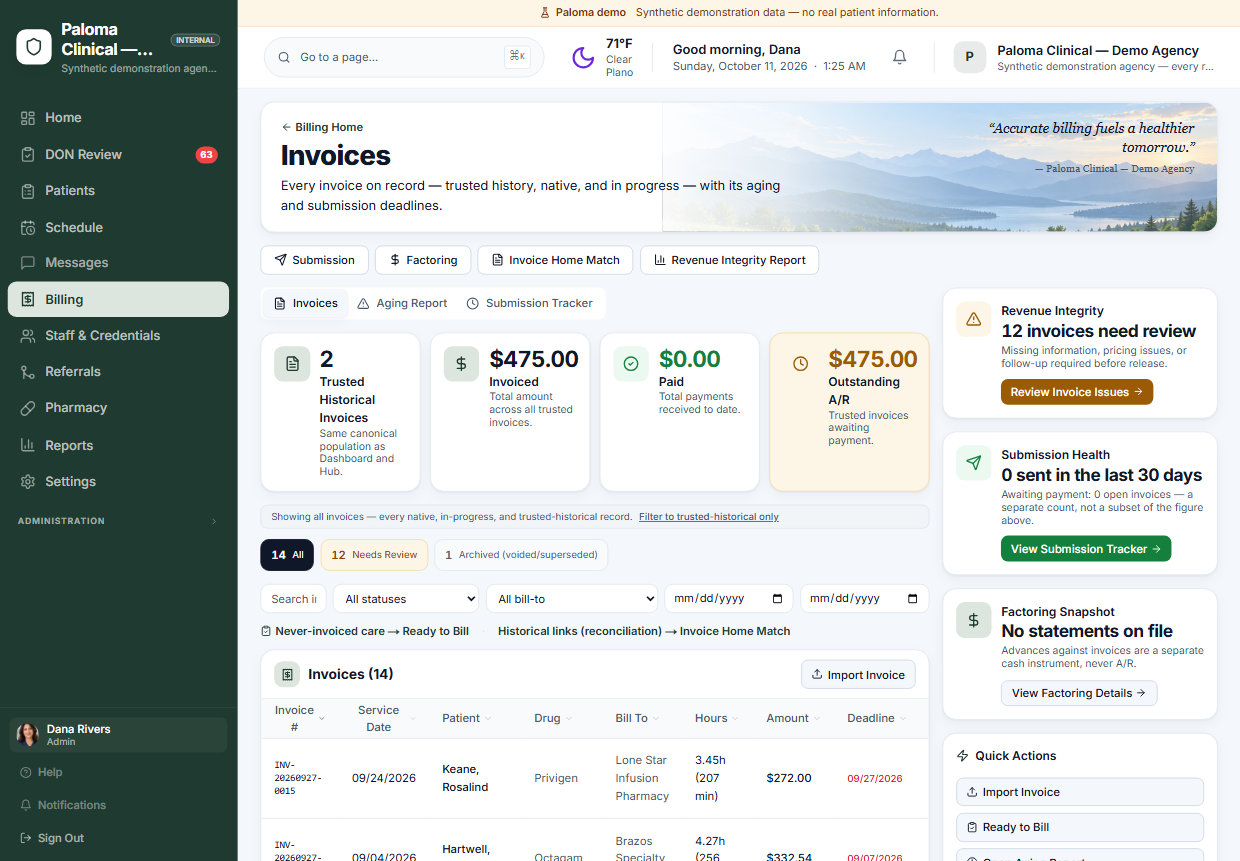
One billing record, several formats
The destination is one billing record for each service: who is paying, under which authority, the line with its code, units and rate, and the context a claim needs. An invoice to a pharmacy, an institutional claim form, a professional claim form and an electronic claim sent through a clearinghouse are then formats of the same lines. The lines add up to the total on every one of them, because there is only one set.
It follows that producing a form is never the hard part and never the place to fix a fact. A value that is absent from the record is shown as absent on the worksheet, with its source named, and is corrected where it belongs. A form filled with defaults looks finished and is wrong.
Payment, remittance and reconciliation
A payment is an event with a date, an amount, a payer and the lines it pays. A remittance explains it: what was paid, what was adjusted, what was denied and why. Reconciliation is matching the two back to the billing lines so that every visit ends in a known state: paid in full, short-paid with a reason, denied, or still outstanding.
Some agencies sell their receivables, so the party that pays is not the party that was billed. Some customers pay on a statement covering many invoices. Some payers pay a period at a time. In each case the question is the same: for this visit, what was billed, what came back, and what is still owed.
Corrections follow one rule. A payment or an invoice is corrected by a new entry that preserves the original. What was sent to a customer on a date remains readable as it was sent.
Rules
What a revenue-cycle engine must refuse to do.
Borrow a rate
When no pricing rule is in force for this party on this date, the line stops there. It never takes another customer’s rate, last year’s rate or a schedule default.
Assume the payer
The party being billed is established by a billing authority, never inferred from the patient’s referral source or from whoever paid last time.
Fill a form with defaults
A claim field the record cannot support is shown as missing, with its source named. A form that looks complete and is wrong costs more than one that is visibly unfinished.
Treat typed terms as a contract
Rates someone entered are reported terms. A signed agreement on file is documented. The two are named differently and can support different things.
Bill what was not reviewed
A note that has not passed clinical review does not produce a line, however long the visit has been waiting.
Overwrite history
Rates, authorizations and code sets carry effective dates. An older visit is priced by the rule in force on its date, and a correction never erases what was issued.
What this means for the people doing the work
The scheduler sees, when booking, that an authorization line has two visits left and ends on the thirtieth. The clinical reviewer sees what this payer requires in the note before approving it. The biller starts the day with a list of what can be billed and a second list of exactly what is holding up the rest. The owner sees revenue that has been earned and not yet billed as a number with names beside it.
It also means the compliance and revenue views of a visit cannot drift apart. The evidence a payer may audit is the same evidence a surveyor may sample: the order, the authorization, the clinician’s qualifications, the note and its review. An agency that can show one can show the other.
The platform → Continuous compliance → Payer and program models →
Paloma Cares
See it in Paloma Cares
Paloma Cares bills from reviewed care, at the terms each customer has agreed. The pharmacy workflow shows it from order to invoice, and the price is published.
From Paloma Cares
What Paloma Cares supports today
This list is published by Paloma Cares and was last verified on 2026-10-10. palomacares.com is the source for what the product does now.
- Pharmacy invoices, statements and paymentsLiveSee it in Paloma Cares →
- Authorization trackingLiveSee it in Paloma Cares →
- Pharmacy portal for pharmacy partnersLiveSee it in Paloma Cares →Read-only governed access for pharmacist, case-manager and billing-contact roles. Sending orders, messaging and downloads are under development.
- UB-04 worksheet for VA Community CareIn progressSee it in Paloma Cares →A worksheet that names the source of every value and what is not on file. Not a submission-ready claim.
- Electronic payer claims, eligibility and remittancePlatform direction
- Exports and a verified agency backupLiveSee it in Paloma Cares →
- Medicare-certified home healthNext service line
Questions
Revenue cycle: common questions
Where does the revenue cycle of a healthcare agency begin?
At the authorization, well before any invoice or claim. What may be billed is decided by who ordered the care, what a payer approved, and what agreement or program sets the price. A billing process that starts at the billing screen inherits whatever was wrong upstream and discovers it as a denial.
What is the difference between clinical authority, service authorization and billing authority?
Clinical authority is what a practitioner ordered. Service authorization is what a payer approved, by discipline, dates and quantity. Billing authority is who pays and on what terms: a contract, a payment authorization or a fee schedule. They can arrive in different documents on different days, and each can change without the others.
Why are care delivered, units reported and payment basis treated as three facts?
Because they are counted differently. One nursing visit is one clinical encounter. On a claim it may be reported as several timed units. It may be paid per visit, per hour, per unit, or as part of a payment for a whole period of care. Holding one number for all three is how an agency bills the wrong quantity for correct work.
Can one system bill a pharmacy, a government program and a family?
Yes, when it represents the relationship first: who the agreement is with, what it authorizes, how it prices and how it must be told. A pharmacy invoice, a paper claim form and an electronic claim are then formats of the same billing lines.
What should happen when a rate or an authorization is missing?
The work should stop at that point and say which fact is missing. A system must never borrow another payer’s rate, an older rate or another patient’s authorization to complete a bill. A visible gap is recoverable; an invented value is a repayment waiting to be found.
How should a billing correction be handled?
As a new event that preserves the original. An invoice or payment that is overwritten leaves books that no longer match what the customer was sent. A correction records what changed, who changed it and why, and both versions remain readable.
Why does revenue cycle belong in the same system as clinical care?
Because a visit is billable only when the record supports it: a governing order, an authorization with quantity remaining, a qualified clinician, a reviewed note. When those live in the same record as the bill, the reason a visit cannot be billed is known on the day of the visit.
The products
The software doing it.
Use either independently. Use them together when you want patient demand and workforce supply to work from the same context.