
Paloma Cares + Paloma Talent
Clinical demand meets workforce supply.
Staffing should begin with the care that actually needs to be delivered. Paloma Cares understands the work that has to happen. Paloma Talent understands the workforce capable of doing it. Each is complete on its own. Connected, staffing stops being a separate administrative exercise.
Two questions every agency answers every day
What work exists, and who can do it. In most organizations these are answered in different systems by different people. The clinical system knows a patient needs a nurse on Tuesday in a town forty miles out. The recruiting system knows who applied last month. Nothing connects them, so when a referral arrives where the agency has no one, somebody leaves the chart, opens a job board, writes a posting from scratch, screens whoever replies, and later carries the result back by hand.
Meanwhile the referral source is asking other agencies the same question. How fast an agency can say yes, and mean it, often decides whether it keeps the patient.
What work exists? Paloma Cares. Who can do it? Paloma Talent.
The path
From a patient’s need to revenue, without re-describing the need.
- Clinical demand arises
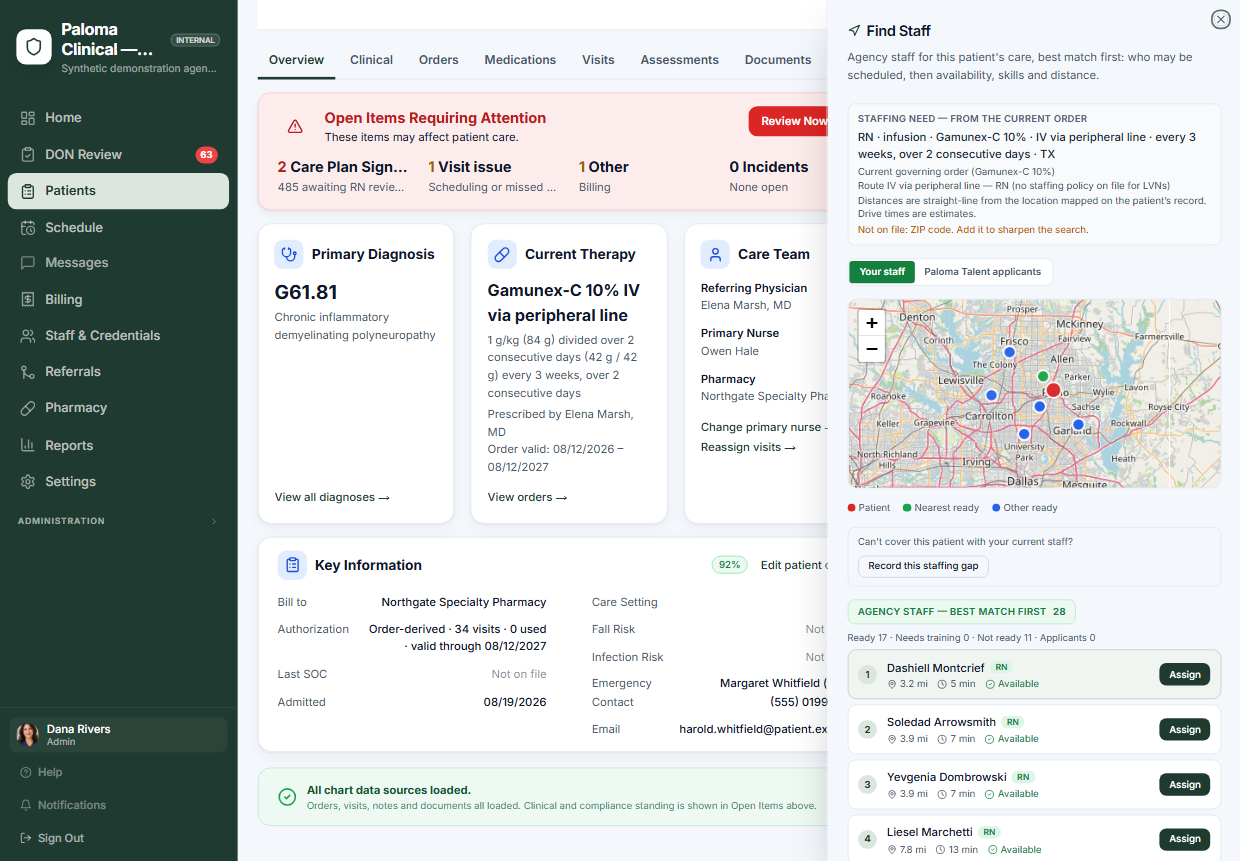
- Agency’s own workforce searched
- Ranked by eligibility, distance, availability and skill
- Extended to Paloma Talent if unfilled
- Recruit and engage
- Credential and onboard
- Assign to the actual care
- Care delivered and documented
- Compliance, payroll and revenue from the same event
The patient’s need is the specification
By the time care is ordered or authorized, the operating record already holds almost everything a recruiter would ask: where care will be delivered, which discipline, what the care requires of the clinician, how often, when it must start, and what the payer or program permits. That is the staffing requirement. It does not need to be invented as a job description.
Own staff first
The first question is whether the agency’s existing workforce can cover it. The agency’s clinicians are listed against the same readiness rules the schedule enforces: license, required credentials and clearance, then availability, competency for this care, and distance. Anyone not ready shows exactly what is missing. Choosing a ready clinician opens the visit with patient and clinician already in place.
Then the network
If nobody on staff can cover the need, the same requirement extends to Paloma Talent: the role, the skills the care implies, the place and the timing, with no patient-identifying details leaving the agency. What comes back are prospects near the patient, with the evidence behind each match. They are leads, not staff. A prospect’s license reads as not verified until the agency verifies it through its own hiring process. From the same screen the agency can reach out or invite a prospect to apply, and the applicant enters the agency’s own hiring file.
Every service line
Any authorized or ordered service is workforce demand.
The shape of the requirement changes with the business. The path from requirement to clinician to care does not.
| Line of business | What creates the demand | What the requirement looks like |
|---|---|---|
| Home infusion and specialty pharmacy nursing | A referral and order from a pharmacy | A nurse competent in this therapy and access device, near this patient, on the dosing schedule |
| Medicare-certified home health | An admission and a plan of care | Each ordered discipline at its own frequency: nursing, physical, occupational and speech therapy, social work, aide |
| Hospice | An election and the interdisciplinary plan of care | Nurse, aide, social worker, spiritual counselor and on-call coverage across the census |
| Infusion suites | Scheduled chairs | Nursing by time block, volume and therapy skill |
| Private duty | Authorized or contracted hours | Recurring shifts for one patient, with clinicians oriented to that case |
| Personal care and home care | Service hours in a care plan | Aides by hours, days and tasks, with continuity for the client |
| VA and Medicaid programs | An authorization with service lines | The discipline, quantity, frequency and dates the payer approved |
| Healthcare staffing | A client’s order for a shift or assignment | The client’s role, unit, dates and compliance file requirements |
Eligible, not only nearby
Finding the nearest nurse is the easy part. The question that protects the patient, the claim and the survey is whether this clinician is eligible for this assignment.
The right license
The correct license type for the service, valid in the state where care is delivered, and checked at the source.
Competency for this care
Demonstrated competence for the therapy, the device or the population, not a general assumption.
Current credentials
Certifications, health records and training in date on the day of the visit, not on the day of hire.
Screening
Background and exclusion screening as the agency, the payer or the program requires.
The agency’s own rules
Orientation, policy acknowledgments and anything the agency’s policies add.
The service line and the payer
Requirements that attach to this kind of care or this program, by date.
So the chain is longer than search and hire. It runs from demand to candidate to qualification to assignment to care to evidence to compliance to revenue. A clinician found through the network becomes a member of the agency’s workforce with a file, and the file governs what they can be assigned to. That is the point at which the two products together are an operating platform and not an electronic record beside a job board.
Each product stands on its own
The integration is the advantage. The products do not depend on each other.
Paloma Talent is a workforce product for any healthcare organization: a hospital, a clinic, a surgery center, a staffing company, a hospice, a home health agency, an infusion company. It does not depend on which service line the organization runs or on using Paloma Cares.
Paloma Cares runs an agency’s clinical, administrative, compliance and revenue operations. An agency can use it without being asked to recruit through Talent.
When an organization uses both, the system understands both sides of the equation at once, and a staffing gap is visible as what it is: care that has been ordered or authorized and has no one assigned.
Paloma Cares
Two products, one context
See Paloma Cares and Paloma Talent together: staffing searched from the patient’s chart, your own eligible clinicians first. Each shows what it does, with a published price and a way to start.
From Paloma Cares
What Paloma Cares supports today
This list is published by Paloma Cares and was last verified on 2026-10-10. palomacares.com is the source for what the product does now.
- Find Staff from the patient chartLiveSee it in Paloma Cares →The staffing need is worked out when Find Staff is opened from a chart, referral or visit.
- Paloma Talent (for any healthcare organisation)LiveSee it in Paloma Talent →Usable by any healthcare organization, with or without Paloma Clinical.
- Workforce files, hiring and onboardingLiveSee it in Paloma Cares →
- Credential and licence trackingLiveSee it in Paloma Cares →
- Scheduling with staff readinessLiveSee it in Paloma Cares →
- Staffing needs opened automatically from referralsPlatform direction
- Licence monitoring against the authoritative sourcePlatform direction
Questions
Paloma Cares and Paloma Talent: common questions
What does “clinical demand meets workforce supply” mean?
The care record already holds what a recruiter would ask: where care is delivered, which discipline and skills are required, the credentials, and the timing. That need is used directly as the staffing requirement, searched first against the agency’s own eligible staff and then against a wider workforce network, instead of being described again in a separate recruiting system.
Do Paloma Cares and Paloma Talent depend on each other?
No. An agency can run its operations on Paloma Cares without recruiting through Paloma Talent, and any healthcare organization can use Paloma Talent without Paloma Cares. The integration is the advantage, not a requirement.
How is this different from an applicant tracking system?
An applicant tracking system starts with a job requisition somebody wrote. This starts with an actual patient or service that needs a particular clinician in a particular place at a particular time, and it carries that requirement through hiring, credentialing and assignment to the visit itself.
Does it only apply to nursing or to home infusion?
No. Any authorized or ordered service creates a workforce requirement: a therapy discipline in home health, an aide’s hours in personal care, a shift in private duty, a chair-time block in an infusion suite, an interdisciplinary team member in hospice.
How does the system know a clinician is eligible, not just nearby?
Eligibility is judged from the clinician’s file: the right license, required competencies, current credentials and health records, screening, and any requirement of the agency, the payer or the service line. A prospect who is not yet on the agency’s staff is a lead whose license reads as not verified until the agency verifies it through its own hiring process.
Is patient information shared with the workforce network?
No patient-identifying details leave the agency. The requirement that is shared describes the role, the skills the care implies, the place and the timing.
The products
The software doing it.
Use either independently. Use them together when you want patient demand and workforce supply to work from the same context.