
Continuous compliance
Survey-ready as the agency operates.
Most software helps an agency record what happened. Paloma is built to go further: to take the rules an agency is held to and continuously examine how the agency is actually operating, so exposure is found on an ordinary Tuesday and not on survey day.
A survey does not begin when the surveyor arrives. By then the evidence exists, or it does not.
Paloma’s objective is to make survey readiness an operating condition and not a pre-survey project. It is designed around the operational obligations agencies face under state regulation, CMS requirements, accreditation programs such as CHAP, ACHC and The Joint Commission, payer requirements and the agency’s own policies.
What survey readiness actually means, from inside the agency →
- Regulation or standard
- Agency policy
- Operational obligation
- Workflow control
- Evidence from real work
- Continuous surveillance
- Exception
- Corrective action
- Survey-ready evidence
The question every survey asks
Strip away the forms and a survey asks one thing: does this agency operate the way the rules, and its own policies, say it does. The rules come from several places at once. Medicare sets Conditions of Participation. The state sets licensing rules. An agency that chooses accreditation is also surveyed against the standards of its accrediting organization; CHAP, ACHC and The Joint Commission are among those CMS approves. Which of these apply depends on the agency’s state, its certification and the programs it has chosen. Payers add terms of their own. The agency’s policy manual says how it will meet all of them.
The evidence that it did is not in the manual. It is scattered through charts, personnel files, schedules, supervisory visit logs, meeting minutes, complaint logs and invoices, and a surveyor samples it one patient, one clinician and one visit at a time. How a survey actually proceeds, and why a binder cannot answer it, is described separately.
Software has mostly treated this as a library problem: store the policies, store the documents, print a binder. That does not tell anyone, weeks earlier, that a supervisory visit is overdue, that a nurse was scheduled past the expiry of a credential, or that a required assessment was never signed.
From a library to a system that watches
Paloma’s model treats each requirement as an obligation with six things attached: where it comes from, whom or what it applies to, how often it falls due, what evidence satisfies it, who owns it, and from what date it applies. The system then looks at the agency’s operational record and classifies each obligation: satisfied, evidence missing, cannot be determined, or not applicable.
A gap becomes an open item with an owner and an age. It closes when the evidence appears, and the closing is recorded. Nothing has to be remembered, and nothing is tidied away before a survey, because the record of what was open and when it closed is itself the proof that the agency governs its work.
Your policy requires this. This patient, employee or visit shows that. This evidence is missing, and here is who owns it.
One visit
What the system should understand when a nurse charts.
A visit is not only a note to be stored. It is the point where clinical, workforce, payer and regulatory requirements all have to be true at the same moment.
| Question | What answers it | Who asks later |
|---|---|---|
| Was the clinician qualified and currently eligible to perform this service? | The license and its verification, required competencies, health and screening records, and their dates relative to the visit | Surveyor, accreditor, payer, the client in a staffing arrangement |
| Was there a valid governing order? | One governing clinical authority in force on the visit date, with the provenance and approval required for that service line; a revision is a new order | Surveyor, pharmacy, payer |
| Was the service delivered the service that was authorized? | The authorization line the visit was performed under: discipline, dates, quantity and frequency | Payer, auditor |
| Were the required assessments completed, on time? | The assessment, its completion date and the rule that sets its deadline | Surveyor, quality reviewer |
| Is the documentation sufficient for this kind of visit? | The note checked against what this service line, discipline and payer require, before it is approved | Clinical reviewer, payer |
| Were medications, supplies, signatures and interventions captured? | Structured entries in the note, tied to the order and to stock | Surveyor, pharmacy, biller |
| Did agency policy require anything further? | The agency’s own adopted policies, linked to the obligations they create | Surveyor, the agency’s governing body |
| Did the visit create a billable service, and is anything missing before billing? | The billing rule for this payer applied to the facts of the visit | Biller, payer, auditor |
One agency
The same reasoning runs at the level of the business. A single late assessment is an exception. The same assessment late for a third of admissions is a pattern, and patterns are what conditions and standards are written about. An agency needs to see, continuously, where its current operations do not yet support the evidence it will be asked for.
That means watching the things a survey samples, across every patient and every employee, without waiting for someone to run a report: credentials approaching expiry against the schedule that depends on them; orders awaiting signature and how long they have waited; supervisory visits against their intervals; assessments against their deadlines; personnel files against what each role requires; complaints and incidents against their follow-up; quality and emergency-preparedness activities against their calendar; and the agency’s own policies against the date each was last reviewed.
The output is not a score. It is a list of specific, owned, dated items, each tied to the requirement it comes from and the record that would close it.
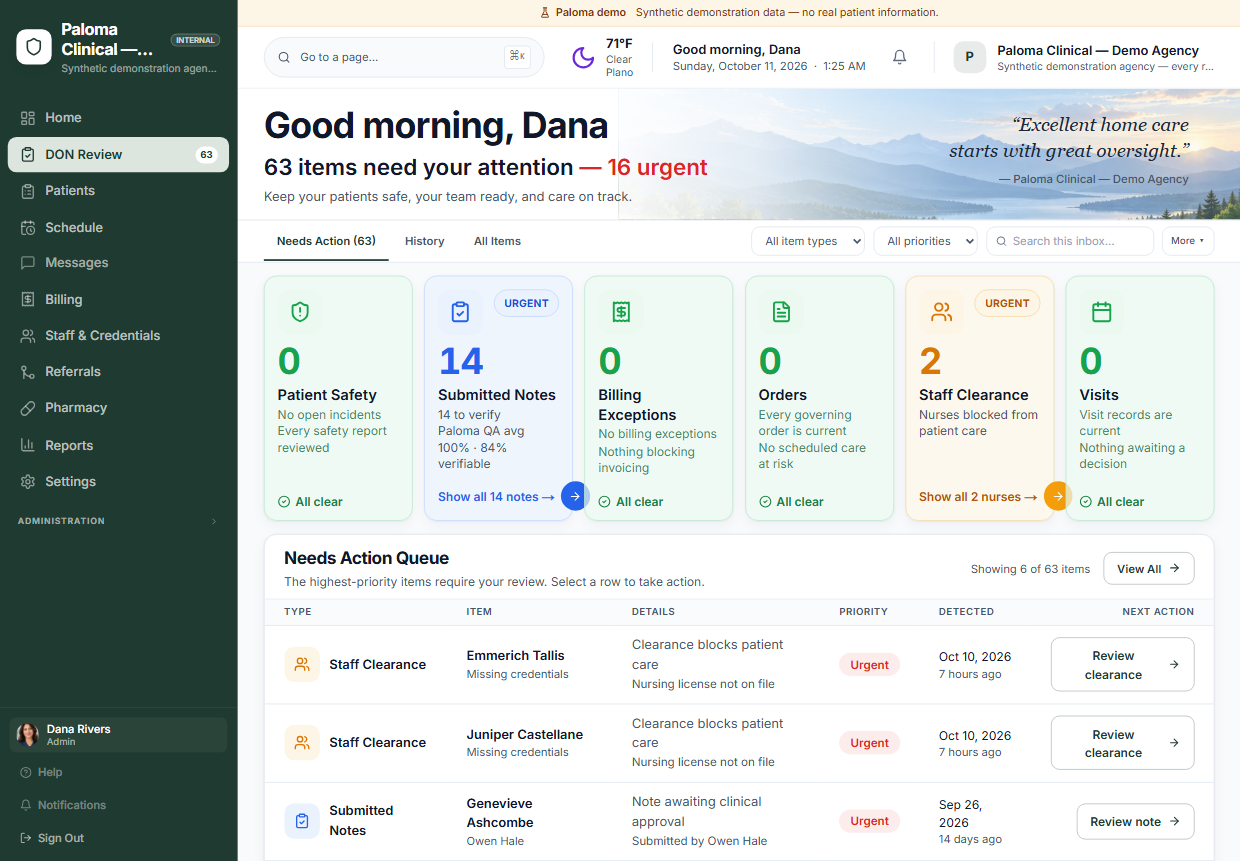
The agency’s own policies are part of the rule
An agency’s policies are its promises about how it will work. Surveyors read them and then test the agency against them, which is why a policy that promises more than the agency does creates a finding even when the regulation would have been satisfied.
In Paloma’s model a policy is not a file in a folder. It is held beside the regulations and standards it answers to, and it carries the obligations it creates: who must do what, how often, with what evidence. A person at the agency confirms those obligations. From then on the system can compare what the agency says it does with what its operations show.
Evidence has a ladder
Compliance fails quietly when a system lets a weak fact stand in for a strong one. A license number someone typed is not a verified license. An uploaded copy is not a check with the board. A value that software read off a document is a reading. Paloma keeps these apart by name, and applies the same ladder to contracts, orders and authorizations.
| State | What happened | What it can support |
|---|---|---|
| Reported | Someone typed it or said it | Operations can proceed where a rule allows; nothing is proven |
| Documented | A supporting document is on file | Documentary evidence that the fact was claimed and by what |
| Extracted | Software read values from a document | A reading to be confirmed, never a verification |
| Verified | An authorized person, or a direct connection to the source, checked it and recorded the source, time and result | The word “verified”, and anything a rule reserves for it |
| Stale or failed | A verification passed its re-check date, or the source did not confirm | Nothing, until it is checked again |
Two further rules keep the record honest. The absence of evidence is recorded as missing evidence, never as a deficiency: the system does not accuse where it cannot see. And a page is not assumed to belong to a patient because it arrived in the same fax. Identity is established for the evidence itself.
Rules change, and the system should know when
Conditions of participation, state rules, accreditation standards and payer terms are revised on their own calendars, and survey guidance changes with them. Held as dated, sourced rules by jurisdiction, license type, accreditor and payer, a change in the rule is a change in data applied from its effective date. The agency’s history is still judged by the rule that was in force when the work was done.
Two systems, or one
Most platforms separate the work from the oversight of the work.
Care delivery and billing run in an operating system. Quality, accreditation and survey readiness run in another, fed by reports, uploads and audits of the first. Paloma is built on a different model: the work itself produces the evidence, and the same system continuously evaluates that evidence against the obligations governing the agency.
The difference shows when one requirement is followed all the way down. Take a standard that an accrediting organization, a state and Medicare each express in their own words: the people who deliver care must be qualified to deliver it, and the agency must be able to show that they were.
| Step | In a system that watches its own work |
|---|---|
| The requirement | Held as a dated rule with its source: which body, which standard or regulation, in force from when. |
| The agency’s policy | The agency’s own statement of how it meets the requirement, linked to it, with the date it was last reviewed. |
| The required actions | What the policy obliges. For example, where applicable law, accreditation standards, payer requirements or agency policy require it: verify the license at the authoritative source before first assignment and on a schedule, hold current competencies for the therapy, keep health records in date. |
| The workflow that enforces them | Assignment and scheduling read the clinician’s file. A visit that the file cannot support is stopped or flagged when it is booked. |
| The evidence | The specific records the work produced: this verification, by this person or source, on this date; this competency; this visit assigned after both. |
| The exceptions | The exact cases across the agency where the evidence is missing or out of date, by clinician and visit. Seven of them, not a percentage. |
| Who owns correction | A named person for each exception, with the date it opened. |
| Whether it was corrected | The evidence that closed it and when, kept as part of the record. |
| What the surveyor can inspect | The requirement, the policy, the sampled clinicians and visits, the exceptions and their closure, in one place. |
A dashboard of compliance documents can show that files exist. This shows whether the agency operated the way the requirement and its own policy say, case by case, and what it did when it did not. The same trace works for an order that must be followed, a medication reconciliation that must occur, an incident that must be investigated, a plan of care that must be current, and a quality program that must act on trends.
The platform
What each engine contributes to readiness.
Compliance is not a seventh system. It reads the other five.
| Engine | What it has to do for continuous compliance |
|---|---|
| Clinical | Produce the evidence as care is delivered: orders with their signatures, assessments with their dates, notes checked against what the visit requires before approval. |
| Administration | Keep the agency’s own record: policies and their review dates, complaints, incidents, quality and emergency-preparedness activity, meetings and their minutes. |
| Revenue Cycle | Refuse to bill what the record does not support, and name the missing fact, so a compliance gap is caught before it becomes a denial or a repayment. |
| Continuous Compliance | Hold the requirements as dated rules, turn them and the agency’s policies into obligations, evaluate them against the record, and manage exceptions to closure. |
| Workforce | Know every person’s license, verification, competencies and health records by date, and stop an assignment the file cannot support. |
| Interoperability | Bring in what is checked elsewhere, such as a board or registry verification or a screening result, with its source and date attached. |
A surveyor’s view, without a scramble
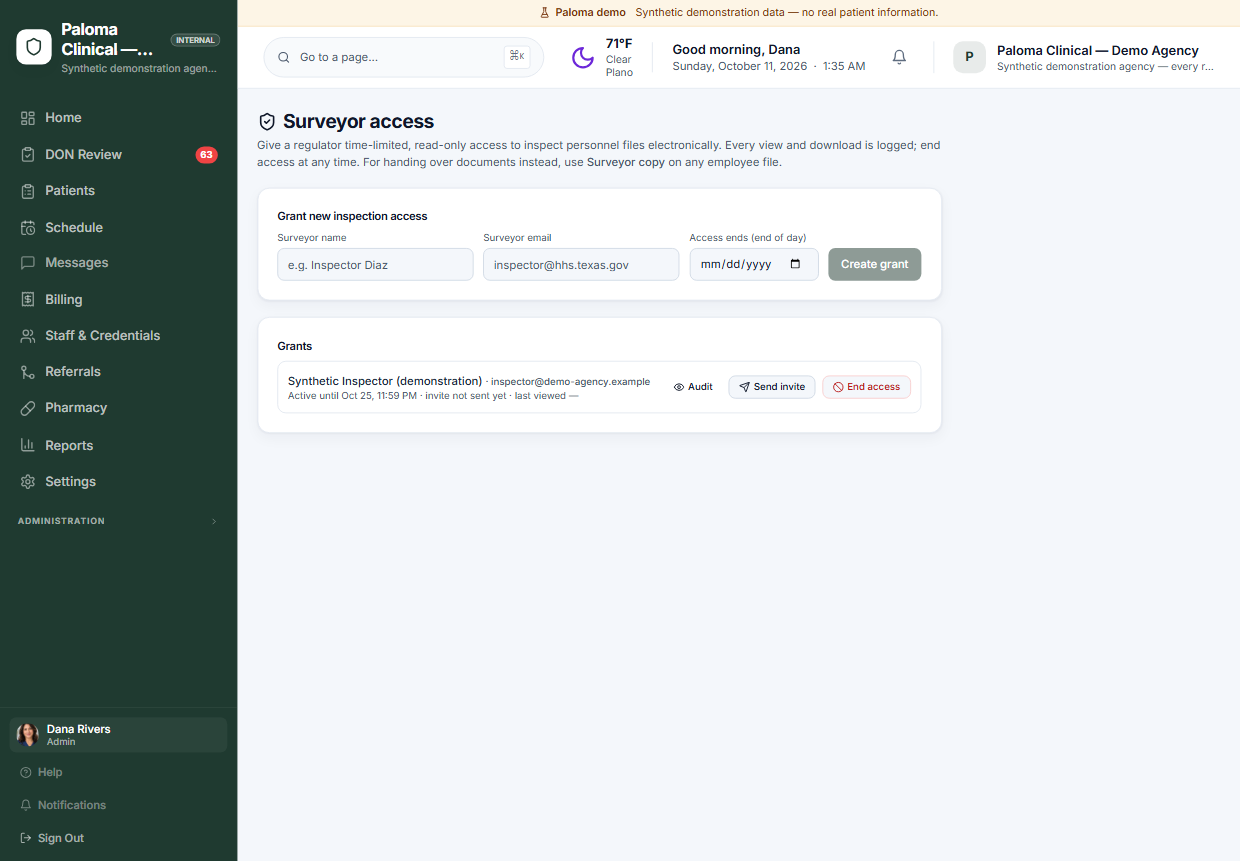
When an inspector arrives, the agency should be able to give them time-limited access to exactly what they are entitled to see, with every view recorded, and answer a sampled request in minutes: this patient’s orders, this nurse’s file, this quarter’s supervisory visits.
The binder still exists for whoever wants one. The difference is that it is printed from what the agency already knows about itself, on any day of the year.
Why this is the center of the company
Clinical documentation, scheduling and billing are necessary and many products provide them. What an agency owner carries alone is the question of whether the business would stand up to inspection today. That question cannot be answered by a module added beside the work, because the evidence is the work.
It is answerable when the patient, the order, the clinician, the visit, the evidence, the obligation and the money are views of the same operational event in one system. That is the architecture Paloma is built on, and continuous compliance is what it is for.
Paloma Cares
See it in Paloma Cares
See how Paloma Cares turns operational evidence into continuous readiness. It shows what the product supports, with its published price and a working demonstration agency.
From Paloma Cares
What Paloma Cares supports today
This list is published by Paloma Cares and was last verified on 2026-10-10. palomacares.com is the source for what the product does now.
- Surveyor access with audit trailLiveSee it in Paloma Cares →
- Credential and licence trackingLiveSee it in Paloma Cares →
- Obligation ledger and survey toolsIn progressSee it in Paloma Cares →Obligation ledger, owned open items, survey binder and survey rehearsal are being strengthened.
- Policy-linked continuous compliancePlatform direction
- Clinical review before billingLiveSee it in Paloma Cares →
- Workforce files, hiring and onboardingLiveSee it in Paloma Cares →
- Licence monitoring against the authoritative sourcePlatform direction
Questions
Continuous compliance: common questions
What is continuous compliance?
An operating model in which every requirement an agency is held to, from federal conditions and state rules to accreditation standards, payer terms and its own policies, is an obligation checked against the agency’s actual work as that work happens. Readiness becomes a daily state of the business instead of a project before a survey.
How is that different from a survey binder?
A binder is a collection of documents assembled for a date. It shows what the agency could gather. Continuous compliance shows what the agency’s operations prove right now, names what they do not yet prove, and gives each gap an owner. A binder can still be produced from it at any time, because the evidence already exists.
Which requirements does the model cover?
It is general by design: state regulation, CMS requirements, accreditation programs such as CHAP, ACHC and The Joint Commission, payer requirements and the agency’s own policies are all sources of obligations. Not every one applies to every agency, so each is held as dated, sourced rules that an agency adopts.
Where do an agency’s own policies fit?
A policy is the agency’s promise about how it will meet a requirement. Linked to the obligations it creates, it lets the system compare what the agency says it does with what its operations show, which is the comparison a surveyor makes.
Does missing evidence count as a deficiency?
No. Missing evidence is recorded as missing, with an owner and an age, until the evidence is supplied or the gap is confirmed. A system that accuses where it cannot see is neither fair nor useful, and one that hides what it cannot see is worse.
Why does compliance belong in the same system as clinical care, staffing and billing?
Because the evidence a surveyor asks for is produced by ordinary work: a signed order, a completed assessment, a credential verified before a visit, a supervisory visit made on time. When that work happens in one system, the evidence is a by-product. When it happens in several, someone has to reconstruct it.
What does “verified” mean in this model?
It names an act, not a field. A license someone typed in is reported. An uploaded copy is documented. A value software read from a document is extracted. Verified means an authorized person or a direct connection to the source checked it and recorded the source, the time and the result. The same ladder applies to contracts, orders and authorizations.
Sources
Where the facts on this page come from
Regulations and program rules change. Each source was read on the date shown.
The products
The software doing it.
Use either independently. Use them together when you want patient demand and workforce supply to work from the same context.